
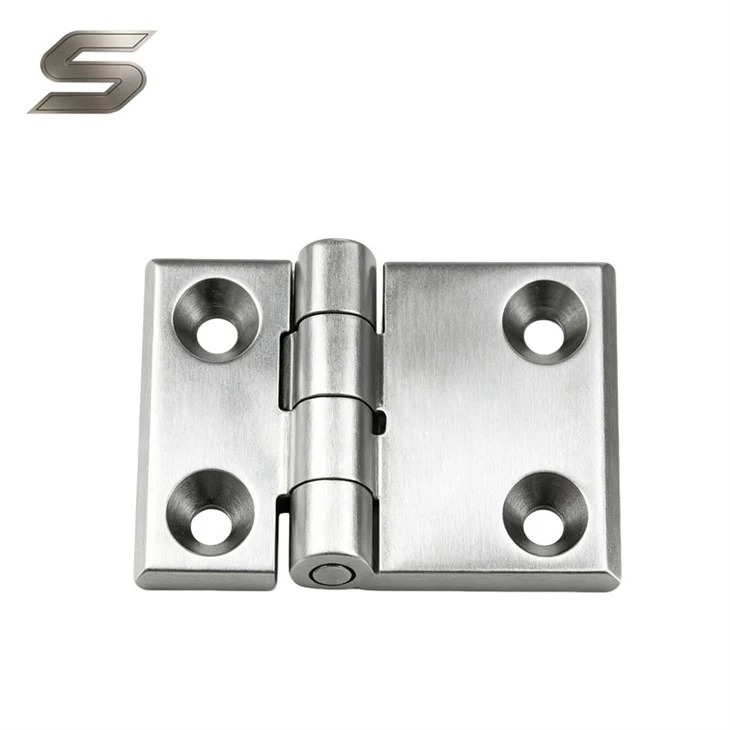
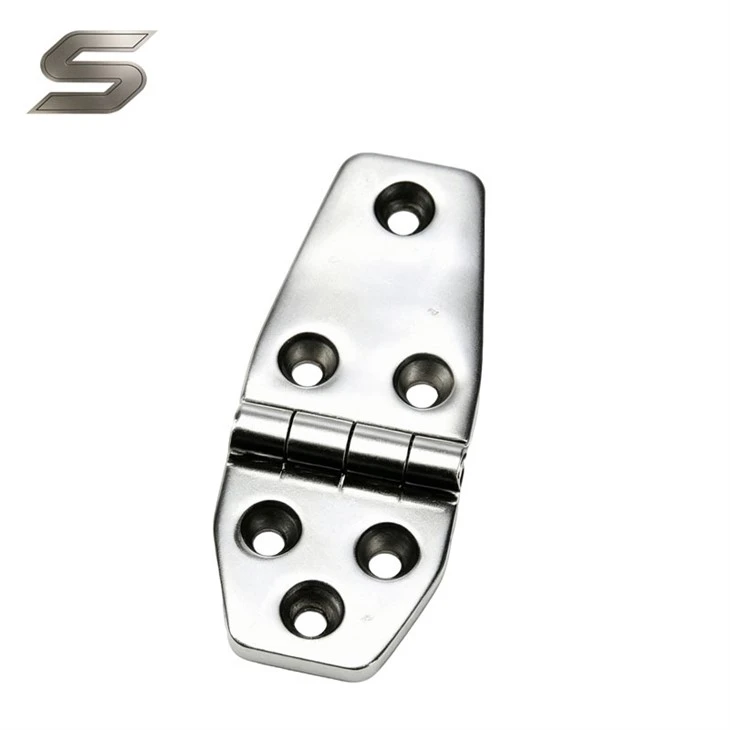
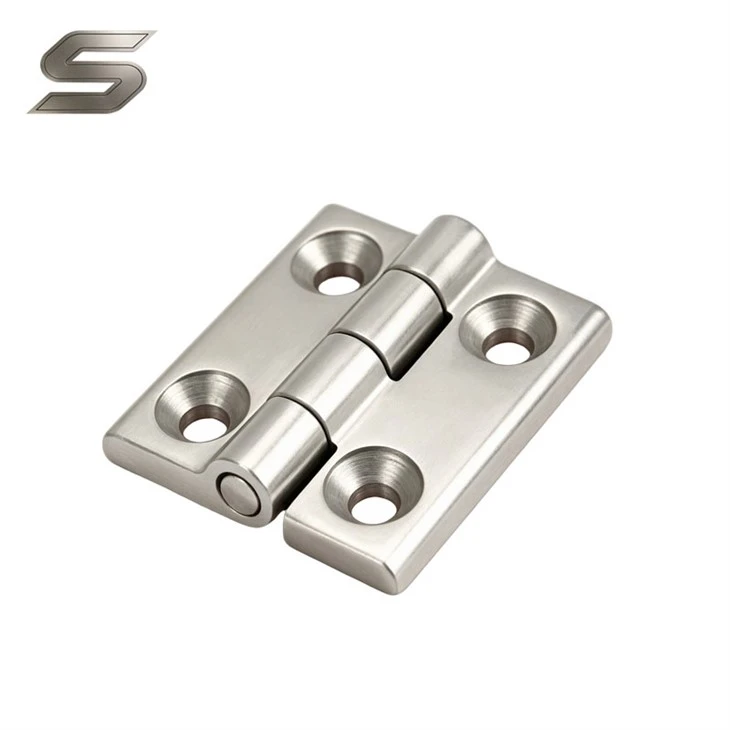
What are precision cast 304 stainless steel hinges?
Simply put, these are stainless steel hinges made using precision casting technology. Their main applications revolve around common corrosion scenarios and food contact, such as food processing lines, pharmaceutical workshops, commercial kitchens, high-end curtain wall doors and windows, and mechanical engineering projects-scenarios requiring basic corrosion protection. They feature extremely high precision, strong corrosion resistance, and high strength, offering excellent cost-effectiveness.
Four Performance Advantages of Precision cast 304 stainless steel hinges:

Excellent Corrosion Resistance
A chromium-rich protective film forms on the surface of 304 stainless steel, suitable for humid environments, daily cleaning, and general outdoor conditions.

Integrity and Stable Load-Bearing
Investment casting allows for the integral molding of hinge ears, reinforcing ribs, and mounting blades, reducing joints and resulting in more stable load distribution.

Capable of Forming Complex Structures
Investment casting can produce rounded corners, bosses, reinforcing ribs, and irregular contours, allowing for customized hinges based on equipment structure.

Good Dimensional Accuracy and Surface Quality
Casting achieves near-finished product dimensions and a relatively smooth surface. CNC machining of key pin holes and mounting surfaces further improves assembly consistency.
How does the coaxiality of hinge pin holes affect opening and closing performance?
For Precision cast 304 stainless steel hinges, dimensional compliance does not guarantee smooth opening and closing. More importantly, it's crucial to check if the multiple pins on the hinge blades are in the same position. While seemingly insignificant, this check affects pin installation, rotational resistance, and lifespan.
International standard ISO 1101 incorporates coaxiality and positional tolerances into its geometric tolerance system. Therefore, this is a standard that casting manufacturers must strictly adhere to. We establish reasonable benchmarks based on the hinge's structural position to ensure its proper function in practical applications. Below, we'll first discuss the problems caused by insufficient coaxiality of the pin holes, and then explain how to correctly represent this on drawings to ensure normal performance.
1. Pin holes may not pass through all hinge holes: When the hole axis is offset, due to the deviation of the pin hole centerline, the pin hole may only pass through a portion of the hole.
2. Uneven opening and closing resistance: This manifests as the hinge receiving pressure from different directions, resulting in smooth operation at one angle and jamming at another.
3. Localized Uneven Wear: Misalignment of the hole axis increases the load on the misaligned side, leading to unilateral wear.
Drawing Requirements:
1. Final diameter and tolerance range of the pin hole.
2. Clearly define the common reference axis requirements for multiple holes.
3. Perpendicularity or positional requirements of the pin hole relative to the mounting surface.
Therefore, you cannot specify the same coaxiality value for all hinges without considering the hinge dimensions, load, pin material, and operating environment. You need to first confirm the actual assembly function of the pin hole, and secondly, if you are unsure about tolerances, consult our technical staff.
Products How to Cast Fillets in Investment Casting?
Fillets are crucial in investment casting. They typically improve metal flow, reduce incomplete filling at sharp corners, reduce stress concentration, and enhance the fatigue resistance of the load-bearing component. The fillet design in Precision cast 304 stainless steel hinges is not designed after casting is complete, but rather integrally formed during the casting process. Therefore, the fillet design occurs during the mold design stage, which is a specific step.
The specific process is as follows:
1. Designing fillets in the 3D model: Engineers first set the fillet radius at the inner corners of the part, at the junctions of wall thicknesses, at the roots of bosses, or at the connections of reinforcing ribs.
2. Incorporating the fillets into the metal mold: When creating the wax model, our engineers directly machine the fillet structure into the mold cavity, then pour the wax model into the mold.
3. Replicating the shape of the wax model in the shell: After assembly, slurry application, and sanding, the wax model forms a ceramic shell. After dewaxing, the interior of the shell retains the cavity shape opposite to that of the wax model.
4. Filling the fillet areas with molten metal: Molten stainless steel is poured into the ceramic shell, and the molten metal flows along the cavity and fills the fillet positions, forming in one step.
5. Cleaning and local finishing: After the stainless steel casting is deshelled, the gate is removed, sandblasted, ground, and passivated.
Note that fillets are typically placed at the connection between hinge lugs and blades, at the roots of reinforcing ribs, in the transition area between thick and thin walls, and around mounting bosses. These locations cannot be designed with sharp right angles, otherwise the molten metal will not fill fully, and cooling shrinkage will be more uneven.
Certification and Quality Documentation Support
Our quality control for Precision cast 304 stainless steel hinges depends not only on the final appearance, but also on raw material confirmation, wax pattern making, casting, CNC machining, and finished product inspection. Currently, Shata has passed international ISO 9001, ISO 14001, and ISO 45001 management system certifications, providing support for the standardized production of your customized hinges.

ISO 9001 Quality Management System Certification
Covers the quality control process from raw material inspection and investment casting to machining and finished product inspection, helping to maintain dimensional and assembly consistency across different production batches.
ISO 14001 Environmental Management System Certification
Implements systematic management of waste gas, wastewater, solid waste, and other environmental factors in casting production, meeting the audit requirements of overseas customers regarding supplier environmental responsibility.
ISO 45001 Occupational Health and Safety Management System Certification
Standardizes safety management in production processes such as smelting, casting, cutting, grinding, and machining, reducing production interruptions and risks associated with human error.
Customization Options
The following are the items we can customize. Please provide the relevant information based on your project requirements.
|
Customizable Items |
Required Information |
|
Hinge Dimensions |
Blade length, width, and overall dimension |
|
Pin Holes |
Hole diameter, hole spacing, and machining tolerances |
|
Hinge Lugs |
Required load and assembly structure adjustments for hinge lug structure |
|
Mounting Holes |
Customized hole positions, countersunk holes, and mounting structures |
|
Reinforcing Ribs |
Reinforcing ribs designed according to load-bearing requirements |
|
Surface Treatment |
Surface Treatment |
|
CNC Machining |
Secondary machining of key areas such as pin holes and mounting surfaces |
Hot Tags: precision cast 304 stainless steel hinges, China precision cast 304 stainless steel hinges manufacturers, suppliers, factory