


Products Description
When handling and transporting non-highly corrosive chemical media like petroleum products, cast aluminum fully meets corrosion resistance requirements and does not contaminate the medium; furthermore, it is lighter and cheaper than cast stainless steel.
Accordingly, a wide range of cast aluminum fuel tank truck parts are used in fuel transportation equipment, including tank trucks and tank trailers.

Advantages of Cast Aluminum Fuel Tank Truck Parts
Safe Petroleum Transportation
Tank trucks carry flammable‑explosive fuels. Sparks from metal‑to‑metal impact may easily ignite the transported media, resulting in fire or explosion hazards.
Aluminum features relatively low hardness. When impact occurs between aluminum components, plastic deformation effectively absorbs impact energy.
Compared with harder materials such as iron, carbon steel and stainless steel, aluminum is far less prone to creating high‑temperature hot‑spots or incendiary sparks, thus improving transportation safety.
Low Machining Cost
Many fuel tank truck components require excellent sealing performance, which calls for precision-machined surfaces and strict dimensional tolerances for multiple part features.
The low hardness of aluminum enables faster and more efficient CNC machining compared with cast iron, cast steel and cast stainless steel.
So the machining costs for cast aluminum fuel tank truck parts are low.
Heat‑Treated Mechanical Strength
A356 is a cast aluminum alloy commonly used for tanker truck components.
After T6 heat treatment, its tensile strength is close to that of gray cast iron, and its yield strength is comparable to that of WCB cast steel and 316 stainless steel.
These enhanced mechanical properties enable it to meet the operating pressure requirements of tanker trucks.
Anodizing‑Enhanced Corrosion Resistance
Combining anodizing with a sealing treatment significantly enhances the corrosion resistance of cast aluminum fuel tank truck parts.
These parts maintain excellent oxidation resistance even when exposed to fuel, air, or water residue from tanker cleaning.
Care must be taken during the handling and assembly of cast aluminum tank truck parts to prevent damage to the anodized film.
Available Tank Truck Parts
We manufacture cast aluminum fuel tank truck parts using two processes: gravity casting (also known as permanent mold casting) and high-pressure die casting.
In principle, we can mass-produce all types of cast aluminum fuel tank components, including valve bodies, manholes and couplings, as long as you provide design drawings that pass our technical feasibility assessment.
We cannot list every single cast-aluminum fuel tank truck part we manufacture here. For clearer presentation, our tank‑truck components are categorized by their respective systems as follows:
- Tank‑top safety accessory system: mainly includes aluminum castings such as manholes, manhole covers, closing and locking mechanisms.
- Vapor recovery system: this system includes many valves, and most of the valve bodies are aluminum castings.
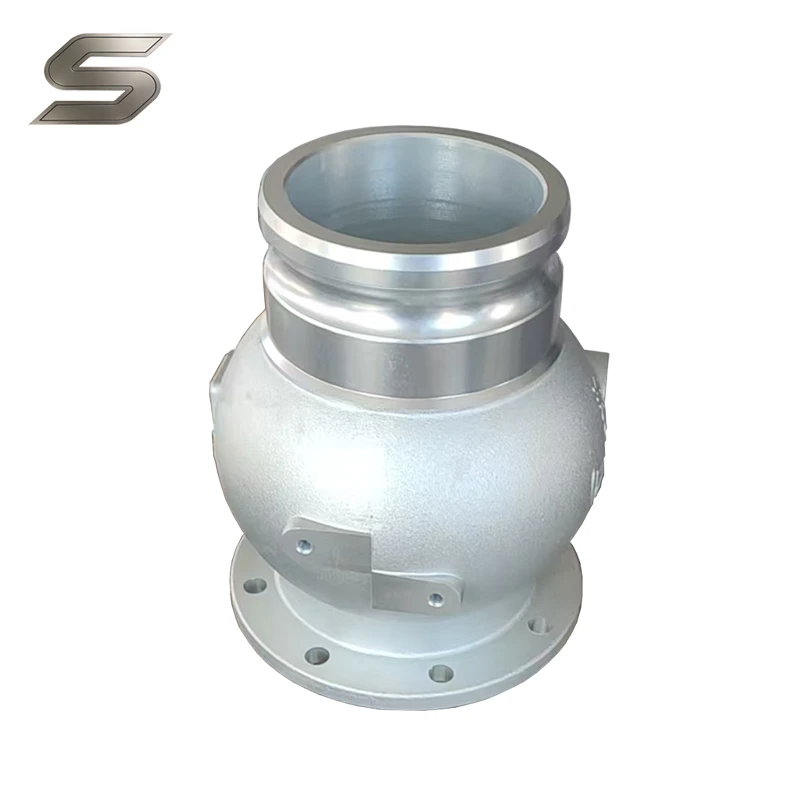
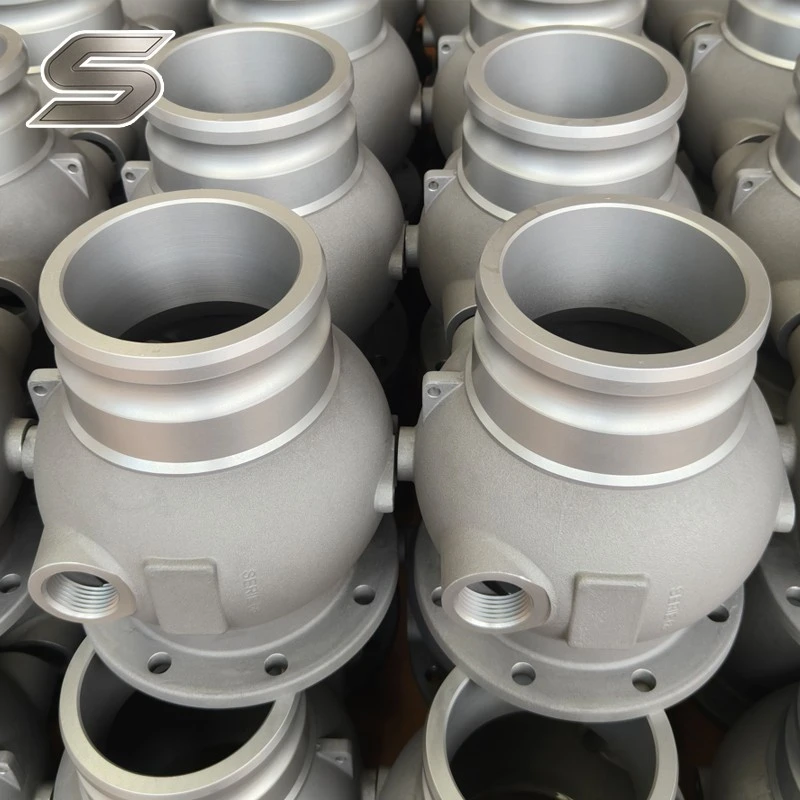
- Bottom loading‑unloading system: typical aluminum castings including bottom valve housings, vapor recovery valve bodies, API adaptor housings, camlocks, and TTMA flanges.
- Pneumatic control system: this system includes aluminum castings such as pneumatic valve bodies, pneumatic control blocks, manifold housings, and pneumatic actuator end covers.
- Overfill‑protection system: includes cast aluminum tank truck parts such as overfill sensor caps, overfill sensor bodies, and socket plug bases.
Material Options
Our mass-produced mainstream cast aluminum grades are A356 (gravity casting) and ADC12 (high-pressure die casting).
In addition to these two materials, we also support the customized production of cast aluminum fuel tank truck parts with the following alloy grades:
- A357
- EN AC 42200
- AlSi7Mg
- A380
- EN AC 46000
Our Quality Control Process
1. Material control
This is a material composition report for our A356 alloy. It precisely records the content of each chemical element; not only do the levels meet specifications, but they also fall within optimal ranges to minimize any potential impact on performance caused by extreme values.
We conduct material testing for all orders of cast aluminum parts for fuel tank trucks and provide similar reports to guarantee material compliance.


2. Dimensional control
For cast aluminum fuel tank truck parts with complex geometries and positional dimensions, we utilize five-axis machining centers.
By employing a unified machining datum across all operations, we eliminate positioning errors associated with multi-stage processing, thereby ensuring product precision and consistency.
During the machining process, we also regularly use measuring instruments to inspect and monitor dimensions, promptly correcting any issues to prevent the production of large quantities of defective parts.
3. Pressure test
This is a critical step: the sealing performance of the cast aluminum fuel tank parts is tested by pressurizing their interiors with gas at or above the working pressure, ensuring that no leaks caused by manufacturing defects occur during use.

4. Anodizing thickness inspection
Most aluminum foundries do not possess equipment for measuring anodizing film thickness; relying instead on inspection results from the anodizing factory, which significantly compromises inspection credibility.
To ensure the anodizing quality of cast aluminum fuel tank truck parts, we have specifically imported professional film thickness gauges from Germany. This enables us to independently verify coating thickness at any time and provide customers with photographic or video evidence of the inspection.

FAQ
Q: Should we do CNC machining before or after anodizing for cast aluminum fuel tank truck parts?
A: CNC machining should be done before anodizing, or it will remove the protective anodized layers of the tank truck parts.
Q: What's your maximum pressure for air pressure test of tank truck parts?
A: Our highest in-house test pressure is 1.6MPa.
Q: Does hard anodizing affect dimensions of tank truck aluminum castings?
A: Yes, a slight dimensional change, 0.01–0.02 mm will be caused by hard anodizing.
For critical sealing & assembly dimensions, we carry out dimensional variation tests during pre-production samples, and adjust CNC machining tolerance in advance to offset the coating thickness deviation for mass production.
Q: How do you eliminate casting porosity to guarantee leak-tight performance?
A: As a professional aluminum castings manufacturer, we have different methods based on various porosity occasions, such as optimizing mold gating system, degasing molten aluminum, adjusting casting parameters, conducting 100% visual appearance inspection, and full hydraulic pressure leak test
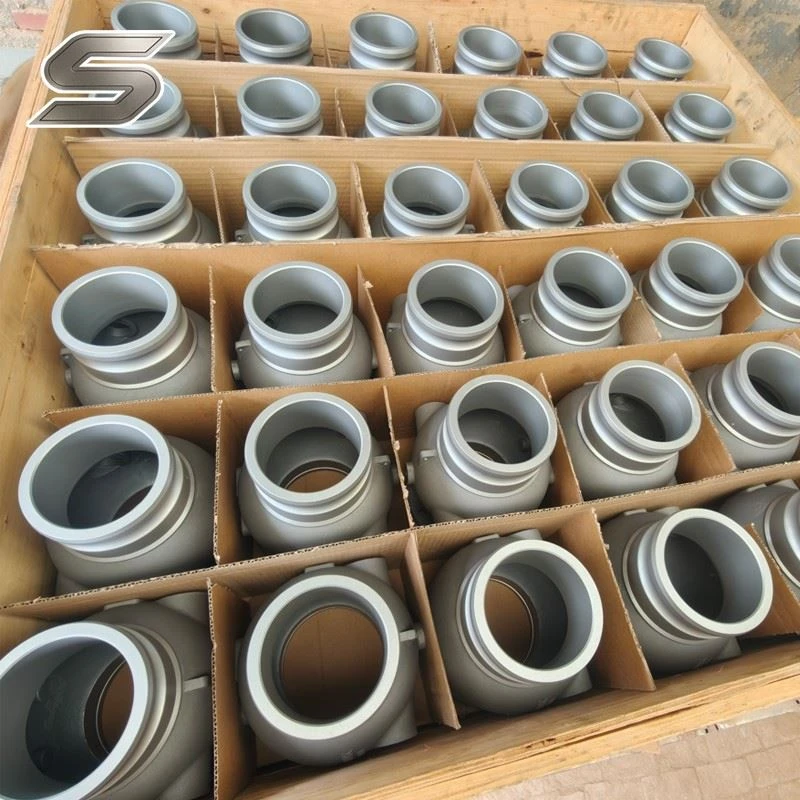
Q: How do you package cast aluminum fuel tank truck parts to prevent collision & scratch damage?
A: We design multi-layer anti-collision export packaging according to shapes and weight of tank truck parts, including internal partitioned carton separation and fumigated solid wooden crates
Q: How to choose between die casting and gravity casting for my cast aluminum parts of tankers?
A:
- Choose casting processes according to required material: ADC12, AlSi12, A380 for die casting; A356, A357, AlSi12Mg, EN AC42100, EN AC42200 for gravity casting;
- For flexible material option orders, choose processes by order quantity & time: large order with limited time, choose die casting; medium-small order, gravity die casting
- According to performance: require strength, pressure-bearing, high temperature & high steam working conditions, choose gravity casting
Q: What is your lead time?
A: Mold & sample development time is 30-40 days;
Bulk order production time ranges from 25 to 50 days based on different technical requirements and quantities.
Q: Are your cast aluminum fuel tank truck parts qualified for oil depot loading & unloading equipment?
A: Yes. The airtight & pressure resistance performance fully meets oil depot fluid transfer equipment safety standards.
we are here for you
Your click opens the door to our partnership!
Hot Tags: cast aluminum fuel tank truck parts, China cast aluminum fuel tank truck parts manufacturers, suppliers, factory, aluminium alloy for pressure die casting, aluminium hpdc casting, aluminum die casting association, die casting technology, high pressure die casting aluminium alloys, low pressure aluminum casting


