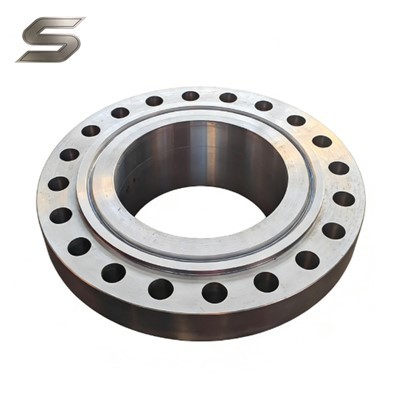



About Our Large Forged Alloy Steel Gears
Large forged alloy steel gears are mechanical components with gears featuring toothed rims, capable of continuous meshing and power transmission. Gears are manufactured by forging alloy steel into gear blanks, followed by machining and tooth profile shaping. These gears feature wear-resistant tooth surfaces, good core toughness, the ability to withstand enormous torque, and even power distribution.

Key Specifications
| Item |
Descriptions |
| Product Name | Large Forged Alloy Steel Gears |
| Material |
Alloy Steel (customized according to usage conditions) |
| Commonly Used Material Grades |
42CrMo4 / AISI 4140, 34CrNiMo6 / Equivalent to AISI 4340, 18CrNiMo7-6, 20CrMnTi |
| Forging Method |
Die Forging, Free Forging |
| Gear Type |
Spur Gear, Helical Gear, Herringbone Gear, Customized Gear |
| Module |
m8-m40 (supports non-standard customization) |
| Number of Teeth |
External Gear : Z20-80; Large Ring Gear: Z100-300 |
| Pressure Angle |
20° (large batch orders support customized processes to produce non-standard pressure angle forged gears) |
| Helix Angle |
8°-20° (helical gear) |
| Tooth Width |
100-800mm |
| Tooth Surface Hardness |
Hardened Tooth Surface According to Customer Requirements |
| Core Hardness |
Depends On Material And Requirements |
| Gear Accuracy Grade |
ISO 1328 Grade 6–8 |
| Impact Toughness |
KV at room temperature ≥ 40 J (depending on material and heat treatment) |
| Tooth Processing Technology | Gear Hobbing, Gear Shaping, Gear Milling, Gear Grinding |
Performance Advantages
Anti-galling Performance
Screen and adjust for non-metallic inclusions, relocating harmful substances to areas far from the subsurface of the tooth surface. We customize the hardening layer depth and implement gradient control of hardness to improve large forged alloy steel gears the stability of the tooth surface structure and inhibit galling.
High Root Bending Strength
Use tooling to shield and protect the tooth root fillets, preventing excessive carburization and the formation of brittle structures. The good root bending strength makes it less prone to surface cracking, thus reducing the likelihood of brittle fracture.
Resistance to Transmission Plastic Deformation
Precisely control the gear's reference dimensions and tooth profile curve during forging. Combined with the high strength and high deformation resistance inherent in the forging process, the teeth will not deform and cause transmission deviation under long-term high-torque compression.
Resistant to Pitting and Spalling on Tooth Surfaces
During the forging process, the gear blank is compressed from multiple angles and directions, focusing on compacting the contact surfaces between the gear and other gears. This ensures a tough transition layer beneath the wear-resistant layer, making it less prone to pitting and spalling.
Stable Meshing
Strictly control the coaxiality of the gear's inner bore, end face, stop, and gear ring. High precision in the inner bore datum and gear ring guarantees the geometric consistency of the large forged alloy steel gear body of the large forged alloy steel gear matrix, resulting in uniform stress and minimal wear after assembly.
Ensuring Overall Machine Safety
Conduct multiple non-destructive tests on critical components to intercept defects before shipment. By setting a reasonable metallographic gradient, residual compressive stress at the tooth root is released, slowing the crack initiation rate when micro-cracks appear on the tooth surface and reducing the impact of gear damage on the entire machine.
From Steel to Finished Gear

Raw Material Selection

Billet Heating

Forging and Shaping

Heat Treatment

Rough Machining

Tooth Profile Machining

Finishing and Tooth Surface Treatment

Quality Inspection
Typical Applications
Mining Machinery
Large forged alloy steel gears are widely used in the transmission systems of mining crushers, ball mills, grinding equipment, and large conveying equipment. They ensure stable operation of mining equipment and reduce downtime for maintenance due to damage to transmission components.
Wind Power Equipment
Used in the core transmission systems of onshore and offshore wind turbines. Gears are manufactured using high-strength carburized steel such as 18CrNiMo7-6, making them less prone to fatigue damage.
Marine Engineering
Alloy steel gears are used in ship propulsion systems and large offshore equipment, ensuring normal power supply to ships and offshore equipment.
Metallurgical and Heavy Industrial Equipment
Forged gears are used in heavy machinery such as large rolling mills, steel production equipment, and industrial reduction systems to complete power transmission and assist in the continuous and efficient operation of heavy equipment.
Inspection & Quality Control
Raw Material Quality Inspection
Before production begins, the steel composition is inspected, and its properties are tested to ensure the material meets requirements for producing high-strength, high-toughness gears.
Forging Process Control
During production, the heating temperature, forging deformation process, and forming quality are controlled to ensure the internal structure of the forged gears is dense, with minimal porosity and cracks.
Heat Treatment Performance Testing
Based on the gear's usage requirements, the hardness of the heat-treated large forged alloy steel gears is tested and its performance verified to ensure the gear surface is wear-resistant, the core is tough, and its performance meets standards.
Internal Quality Inspection
Non-destructive testing methods, such as ultrasonic testing and magnetic particle testing (as needed), are used to inspect the internal quality of the gears and reduce the risk of internal defects.
Comprehensive Quality Inspection
Metallographic inspection, dimensional inspection, tooth profile inspection, and gear precision inspection are performed on the machined gears to ensure smooth meshing between gears after assembly.
Delivery Control
The alloy steel gears are packaged in corrosion-resistant, rust-proof, environmentally friendly, recyclable, and safe wooden crates to prevent damage during transportation and ensure safe delivery.
Custom Orders & Technical Support
Our factory supports custom-made large forged alloy steel gears. We can customize the material grade, module, number of teeth, tooth width, precision grade, and surface treatment scheme based on your provided drawings, samples, and working conditions.
We offer a one-stop service including solution selection, manufacturing, quality inspection, and after-sales technical support, providing precision and reliable transmission gear parts to global buyers.

Hot Tags: large forged alloy steel gears, China large forged alloy steel gears manufacturers, suppliers, factory, closed die forging and open die forging, closed die forging machine, closed die forging press, cold closed die forging, forging open die and closed die, open and closed die forging